
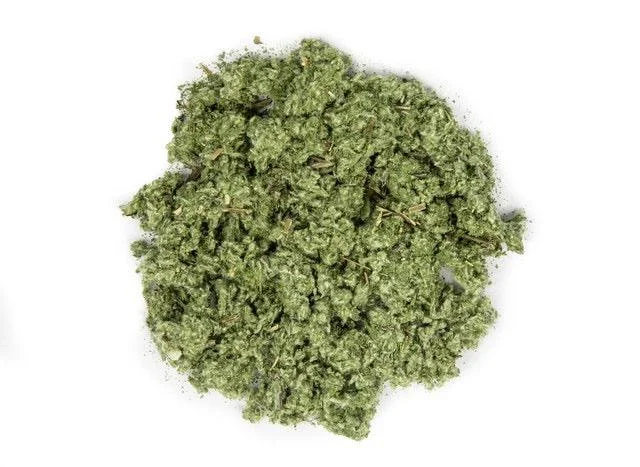
Description
Herbs are Sold By the Ounce, Price is Per Ounce
Mugwort (Artemisia vulgaris)
Family: Asteraceae
Common Names: Common Mugwort, Cronewort, Sailor’s Tobacco, Felon Herb, St. John’s Plant
Botanical : Mugwort is a hardy perennial herb that can grow up to 6 feet tall. It has deeply lobed, dark green leaves with a silvery-white underside, giving the plant a distinctive appearance. The stems are reddish-brown and can be somewhat woody at the base. In late summer, mugwort produces clusters of small, greenish-yellow flowers. The plant has a strong, somewhat bitter aroma due to its high essential oil content.
Habitat and Cultivation: Native to Europe, Asia, and North Africa, mugwort is now found in many temperate regions around the world. It grows wild along roadsides, in fields, and in waste areas. Mugwort thrives in well-drained soil and prefers full sun to partial shade. It is often considered invasive due to its ability to spread rapidly.
Parts Used: Aerial parts (leaves, stems, flowers)
Historical and Folklore Uses:
Mugwort has a long history of use in traditional medicine and folklore. It was used by the ancient Celts and Romans as a protective herb, and it was often placed in doorways and under pillows to ward off evil spirits and bad dreams. In medieval Europe, mugwort was known as a powerful herb for women, used to regulate menstruation and ease childbirth. It was also believed to enhance dreams and was used by herbalists and shamans for divination and lucid dreaming. Mugwort was historically used as a flavoring in beer before hops became the standard.
Energetics and Taste:
- Energetics: Warming, drying
- Taste: Bitter, aromatic
Medicinal Actions:
- Emmenagogue: Stimulates menstrual flow and helps regulate the menstrual cycle.
- Digestive Aid: Stimulates appetite, relieves indigestion, and reduces bloating.
- Nervine: Calms the nervous system and reduces anxiety.
- Antimicrobial: Fights bacterial, viral, and fungal infections.
- Antispasmodic: Relieves muscle spasms and cramps, particularly in the digestive and reproductive systems.
- Mild Sedative: Promotes relaxation and may enhance sleep and dreaming.
System Affinities:
- Reproductive System: Mugwort is most commonly used to regulate menstrual cycles, stimulate menstruation, and relieve menstrual cramps. It is traditionally used to support women’s health, particularly in addressing delayed or irregular periods.
- Digestive System: The herb’s bitter and aromatic properties make it effective in stimulating appetite, improving digestion, and relieving digestive discomfort such as indigestion, bloating, and gas.
- Nervous System: Mugwort’s calming and mildly sedative effects make it useful for reducing anxiety, nervous tension, and promoting restful sleep. It is also known for its ability to enhance dreams and is sometimes used in rituals to promote lucid dreaming.
- Immune System: Mugwort has antimicrobial properties that can help fight infections and support immune health.
Active Compounds:
- Thujone: A volatile compound with mild psychoactive properties, contributing to mugwort’s effects on dreams and the nervous system. It also has antimicrobial effects.
- Flavonoids: Antioxidants that help reduce inflammation and protect against oxidative stress.
- Cineole: An essential oil with antimicrobial, anti-inflammatory, and analgesic properties.
- Coumarins: Compounds with anticoagulant, anti-inflammatory, and antimicrobial effects.
- Tannins: Astringent compounds that contribute to mugwort’s ability to tighten tissues and reduce inflammation.
Uses:
- Menstrual Health: Mugwort is widely used to regulate menstrual cycles, stimulate delayed menstruation, and relieve menstrual cramps. It can be consumed as a tea or tincture for these purposes.
- Digestive
Reviews
There are no reviews yet.